Friday, March 4, 2011

Gimbal Lock

It's all about degrees of freedom ....

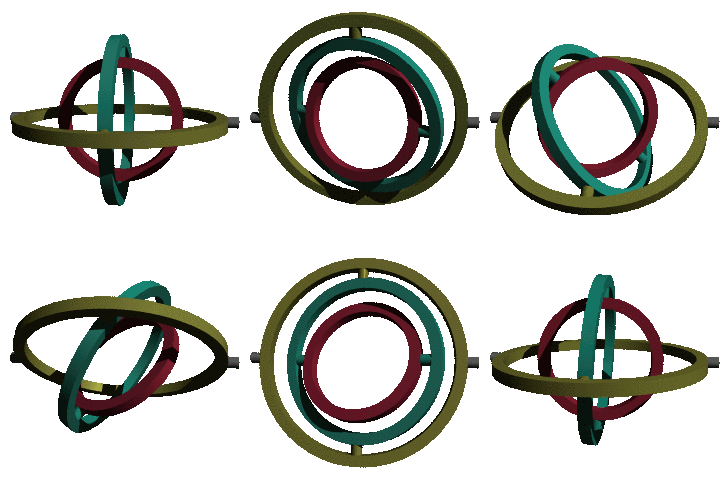
A set of three gimbals mounted together to allow three degrees of freedom. When all three gimbals are lined up (in the same plane), the system can only move in two dimensions from this configuration, not three, and is in gimbal lock. In this case it can pitch or yaw, but not roll (rotate in the plane that the axes all lie in).
Adding a fourth rotational axis can solve the problem of gimbal lock, but it requires the outermost ring to be actively driven so that it stays 90 degrees out of alignment with the innermost axis (the flywheel shaft). Without active driving of the outermost ring, all four axis can become aligned in a plane as shown above, again leading to gimbal lock and inability to roll.

From Wiki:

Gimbal lock is the loss of one degree of freedom in a three-dimensional space that occurs when the axes of two of the three gimbals are driven into a parallel configuration, "locking" the system into rotation in a degenerate two-dimensional space.

The word lock is misleading: no gimbal is restrained. All three gimbals can still rotate freely about their respective axes of suspension. Nevertheless, because of the parallel orientation of two of the gimbal axes there is no axis available to accommodate rotation along one axis.

Gimbals

A gimbal is a ring that is suspended so it c
an rotate about an axis. Gimbals are typically nested one within another to accommodate rotation about multiple axes.

They appear in gyroscopes and in inertial measurement units to allow the inner gimbal's orientation to remain fixed while the outer gimbal suspension assumes any orientation. In compasses, flywheel energy storage mechanisms, or more commonly drink holders, they allow objects to remain upright. They are used to orient thrusters on rockets.[1]

Some coordinate systems in mathematics behave as if there were real gimbals used to measure the angles, notably Euler angles.

For cases of three or fewer nested gimbals, gimbal lock inevitably occurs at some point in the system, due to properties of covering spaces (described below).

Gimbal lock in mechanical engineering

Gimbal lock in two dimensions

Gimbal lock can occur in gimbal systems with two degrees of freedom such as a theodolite with rotations about an azimuth and elevation in two dimensions. These systems can gimbal lock at zenith and nadir, because at those points azimuth is not well-defined, and rotation in the azimuth direction does not change the direction the theodolite is pointing.

Consider tracking a helicopter flying towards the theodolite from the horizon. The theodolite is a telescope mounted on a tripod so that it can move in azimuth and elevation to track the helicopter. The helicopter flies towards the theodolite and is tracked by the telescope in elevation and azimuth. The helicopter flies immediately above the tripod (i.e. it is at zenith) when it changes direction and flies at 90 degrees to its previous course. The telescope cannot track this maneuver without a discontinuous jump in one or both of the gimbal orientations. There is no continuous motion that allows it to follow the target. It is in gimbal lock. So there is an infinity of directions around zenith that the telescope cannot continuously track all movements of a target.[2] Note that even if the helicopter does not pass through zenith, but only near zenith, so that gimbal lock does not occur, the system must still move exceptionally rapidly to track it, as it rapidly passes from one bearing to the other. The closer to zenith the nearest point is, the faster this must be done, and if it actually goes through zenith, the limit of these "increasingly rapid" movements becomes infinitely fast, namely discontinuous.

To recover from gimbal lock the user has to go around the zenith – explicitly: reduce the elevation, change the azimuth to match the azimuth of the target, then change the elevation to match the target.

Mathematically, this corresponds to the fact that spherical coordinates do not define a coordinate chart on the sphere at zenith and nadir. Alternatively, that the corresponding map T2→S2 from the torus T2 to the sphere S2 (given by the point with given azimuth and elevation) is not a covering map at these points.

Gimbal lock in three dimensions


Normal situation: the three gimbals are independent

Gimbal lock: two out of the three gimbals are in the same plane, one degree of freedom is lost
Consider a case of a level sensing platform on an aircraft flying due North with its three gimbal axes mutually perpendicular (i.e., roll, pitch and yaw angles each zero). If the aircraft pitches up 90 degrees, the aircraft and platform's Yaw axis gimbal becomes parallel to the Roll axis gimbal, and changes about yaw can no longer be compensated for (see illustration, red ring is pivoted to green ring and green ring is pivoted to blue ring).
The word lock is misleading: no gimbal is restrained, all three gimbals can still rotate freely about their respective axis of suspension. Nevertheless, because of the parallel orientation of both the yaw and roll gimbal axes, there is no axis available to accommodate yaw rotation.

Solutions

This problem may be overcome by use of a fourth gimbal, intelligently driven by a motor so as to maintain a large angle between roll and yaw gimbal axes. Another solution is to rotate one or more of the gimbals to an arbitrary position when gimbal lock is detected and thus reset the device.

Modern practice is to avoid the use of gimbals entirely. In the context of inertial navigation systems, that can be done by mounting the inertial sensors directly to the body of the vehicle (this is called a strapdown system)[3] and integrating sensed rotation and acceleration digitally using quaternion methods to derive vehicle orientation and velocity. Another way to replace gimbals is to use fluid bearings or a flotation chamber.[4]

Gimbal lock on Apollo 11

A well-known gimbal lock incident happened in the Apollo 11 Moon mission. On this spacecraft, a set of gimbals was used on an inertial measurement unit (IMU). The engineers were aware of the gimbal lock problem but had declined to use a fourth gimbal.[5] Some of the reasoning behind this decision is apparent from the following quote:
"The advantages of the redundant gimbal seem to be outweighed by the equipment simplicity, size advantages, and corresponding implied reliability of the direct three degree of freedom unit."
—David Hoag, Apollo Lunar Surface Journal
They preferred an alternate solution using an indicator that would be triggered when near to 85 degrees pitch.
"Near that point, in a closed stabilization loop, the torque motors could theoretically be commanded to flip the gimbal 180 degrees instantaneously. Instead, in the LM, the computer flashed a 'gimbal lock' warning at 70 degrees and froze the IMU at 85 degrees"
—Paul Fjeld, Apollo Lunar Surface Journal
Rather than try to drive the gimbals faster than they could go, the system simply gave up and froze the platform. From this point, the spacecraft would have to be manually moved away from the gimbal lock position, and the platform would have to be manually realigned using the stars as a reference.[6]
After the Lunar Module had landed, Mike Collins aboard the Command Module joked "How about sending me a fourth gimbal for Christmas?"

Robotics


Industrial robot operating in a foundry.
In robotics, gimbal lock is commonly referred to as "wrist flip", due to the use of a "triple-roll wrist" in robotic arms, where three axes of the wrist, controlling yaw, pitch, and roll, all pass through a common point.

An example of a wrist flip, also called a wrist singularity, is when the path through which the robot is traveling causes the first and third axes of the robot's wrist to line up. The second wrist axis then attempts to spin 180° in zero time to maintain the orientation of the end effector. The result of a singularity can be quite dramatic and can have adverse effects on the robot arm, the end effector, and the process.

The importance of non-singularities in robotics has led the American National Standard for Industrial Robots and Robot Systems — Safety Requirements to define it as "a condition caused by the collinear alignment of two or more robot axes resulting in unpredictable robot motion and velocities".[7]

Gimbal lock in applied mathematics

The problem of the gimbal lock appears when one uses the Euler angles in an application of mathematics, for example in a computer program (3D modeling, embedded navigation systems, 3D video games, metaverses, ...).
In formal language, gimbal lock occurs because the map from Euler angles to rotations (topologically, from the 3-torus T3 to the real projective space RP3) is not a covering map – it is not a local homeomorphism at every point, and thus at some points the rank (degrees of freedom) must drop below 3, at which point gimbal lock occurs. Euler angles provide a means for giving a numerical description of any rotation in three dimensional space using three numbers, but not only is this description not unique, but there are some points where not every change in the target space (rotations) can be realized by a change in the source space (Euler angles).

This is a topological constraint – there is no covering map from the 3-torus to the 3-dimensional real projective space; the only (non-trivial) covering map is from the 3-sphere, as in the use of quaternions.
To make a comparison, all the translations can be described using three numbers x, y, and z, as the succession of three consecutive linear movements along three perpendicular axes X, Y and Z axes. That's the same for rotations, all the rotations can be described using three numbers α, β, and γ, as the succession of three rotational movements around three axes that are perpendicular one to the next. This similarity between linear coordinates and angular coordinates makes Euler angles very intuitive, but unfortunately they suffer from the gimbal lock problem.

Loss of a degree of freedom with Euler angles

A rotation in 3D space can be represented numerically with matrices in several ways. One of these representations is:
\begin{align}
R &= \begin{bmatrix}
\cos \alpha & -\sin \alpha & 0 \\
\sin \alpha & \cos \alpha & 0 \\
0 & 0 & 1 \end{bmatrix} \begin{bmatrix}
1 & 0 & 0 \\
0 & \cos \beta & -\sin \beta \\
0 & \sin \beta & \cos \beta \end{bmatrix} \begin{bmatrix}
\cos \gamma & -\sin \gamma & 0 \\
\sin \gamma & \cos \gamma & 0 \\
0 & 0 & 1 \end{bmatrix} \end{align}
with α and γ constrained in the interval [ − π,π], and β constrained in the interval [0,π].
Let's examine for example what happens when β = 0. Knowing that \cos\, 0 = 1 and \sin \,0 = 0, the above expression becomes equal to:
\begin{align}
 R &= \begin{bmatrix}
\cos \alpha & -\sin \alpha & 0 \\
\sin \alpha & \cos \alpha & 0 \\
0 & 0 & 1 \end{bmatrix} \begin{bmatrix}
1 & 0 & 0 \\
0 & 1 & 0 \\
0 & 0 & 1 \end{bmatrix} \begin{bmatrix}
\cos \gamma & -\sin \gamma & 0 \\
\sin \gamma & \cos \gamma & 0 \\
0 & 0 & 1 \end{bmatrix} \end{align}
The second matrix is the identity matrix and has no effect on the product. Carrying out matrix multiplication of first and third matrices:
\begin{align}
 R &= \begin{bmatrix}
\cos \alpha \cos \gamma -\sin \alpha \sin \gamma & -\cos \alpha \sin \gamma - \sin \alpha \cos \gamma & 0 \\
\sin \alpha \cos \gamma + \cos \alpha \sin \gamma & -\sin \alpha \sin \gamma + \cos \alpha \cos \gamma & 0 \\
0 & 0 & 1 \end{bmatrix} \end{align}
And finally using the trigonometry formulas:
\begin{align}
 R &= \begin{bmatrix}
\cos ( \alpha + \gamma ) & -\sin (\alpha + \gamma) & 0 \\
\sin ( \alpha + \gamma ) & \cos (\alpha + \gamma) & 0 \\
0 & 0 & 1 \end{bmatrix} \end{align}
Changing α's and γ's values in the above matrix has the same effects: the rotation's angle α + γ changes, but the rotation's axis remains in the Z direction. The last column and the last line in the matrix won't change: one degree of freedom has been lost.

The only solution for α and γ to recover different roles is to get β away from the 0 value.
A similar problem appears when β = π.

One can choose another convention for representing a rotation with a matrix using Euler angles than the Z-X-Z convention above, and also choose other variation intervals for the angles, but at the end there is always at least one value for which a degree of freedom is lost.

Note that the gimbal lock problem does not make Euler angles "wrong" (they always play at least their role of a well-defined coordinates system), but it makes them unsuited for some practical applications.

The quaternion solution

Another representation for rotations in 3D space is the quaternions.

A quaternion is a tuple made of 4 numbers (s,\ x,\ y,\ z) that represents a geometrical similarity in the general case. If the relation s2 + x2 + y2 + z2 = 1 is verified, then the quaternion can be used to represent a rotation.
From a practical point of view, a rotation of an angle \mathbf{\theta} around an axis directed by a normalized vector \vec{N} = (x_0, y_0, z_0) is represented by the quaternion
(\cos (\theta / 2),\ x_0 \cdot \sin (\theta / 2),\ y_0 \cdot \sin (\theta / 2),\ z_0 \cdot \sin (\theta / 2) ).\
There is no problem similar to the gimbal lock with quaternions. This can be explained intuitively by the fact that a quaternion describes a rotation in one single move ("please turn \mathbf{\theta} radians around the axis driven by vector \vec{N}"), while the Euler angles are made of three successive rotations.
Besides that, quaternions also have other advantages over Euler angles.

See also

References

  1. ^ Jonathan Strickland (2008). "What is a gimbal -- and what does it have to do with NASA?". http://science.howstuffworks.com/gimbal.htm. 
  2. ^ Adrian Popa (Thu Jun 4 10:47:03 1998). "Re: What is meant by the term gimbal lock?". http://www.madsci.org/posts/archives/aug98/896993617.Eg.r.html. 
  3. ^ Chris Verplaetse (1995). "Overview of Pen Design and Navigation Background". http://xenia.media.mit.edu/~verp/projects/smartpen/node8.html#SECTION00322000000000000000. 
  4. ^ Chappell, Charles, D. (2006). "Articulated gas bearing support pads". http://www.wipo.int/pctdb/en/wo.jsp?IA=US2005043537&DISPLAY=DESC. 
  5. ^ David Hoag (1963). "Apollo Guidance and Navigation - Considerations of Apollo IMU Gimbal Lock - MIT Instrumentation Laboratory Document E-1344". http://www.hq.nasa.gov/alsj/e-1344.htm. 
  6. ^ Eric M. Jones and Paul Fjeld (2006). "Gimbal Angles, Gimbal Lock, and a Fourth Gimbal for Christmas". http://www.hq.nasa.gov/alsj/gimbals.html. 
  7. ^ ANSI/RIA R15.06-1999

External links

Thursday, March 3, 2011

The Physics of Euler's Disk

"I love the sound when the disk stops. "zhhhhhhhOP"! amazing toy!"


Euler's Disk is a scientific educational toy manufactured and distributed by the Toysmith Group of the Damert Company. It was invented by Joe Bendik, and was originally marketed by the Tangent Toy Company.[1] The toy has been the subject of a number of scientific papers, and is used as an example of a dynamic system.

Components and use

The toy consists of a heavy, thick chrome plated steel disk, a slightly concave, mirrored base, and holographic magnetic stickers which can be placed on the disk. The disk, when spun on the mirror, exhibits a spinning/rolling motion, slowly moving through different rates and types of motion before coming to rest.

Euler’s Disk has an optimized aspect ratio and a precision polished, slightly rounded edge to maximize the spinning/rolling time. A coin spun on a table, as with any disk spun on a relatively flat surface, exhibits essentially the same type of motion, but is normally more constrained in the length of time before stopping. The Disk provides a more effective demonstration of the phenomenon than more commonly found items.

Physics

A spinning/rolling disk ultimately comes to rest; and it does so quite abruptly, the final stage of motion being accompanied by a whirring sound of rapidly increasing frequency. As the disk rolls, the point P of rolling contact describes a circle that oscillates with a constant angular velocity ω. If the motion is non-dissipative, ω is constant and the motion persists forever, contrary to observation (since ω is not constant in real life situations).

In the April 20, 2000 edition of Nature, Keith Moffatt shows that viscous dissipation in the thin layer of air between the disk and the table is sufficient to account for the observed abruptness of the settling process. He also showed that the motion concluded in a finite-time singularity.

Moffatt shows that, as time t approaches a particular time t0 (which is mathematically a constant of integration), the viscous dissipation approaches infinity. The singularity that this implies is not realized in practice because the vertical acceleration cannot exceed the acceleration due to gravity in magnitude. Moffatt goes on to show that the theory breaks down at a time τ before the final settling time t0, given by
\tau\simeq\left(2a/9g\right)^{3/5}
\left(2\pi\mu a/M\right)^{1/5}
where a is the radius of the disk, g is the acceleration due to Earth's gravity, μ the dynamic viscosity of air, and M the mass of the disk. For the commercial toy (see link below), τ is about 10 − 2 seconds, at which \alpha\simeq 0.005 and the rolling angular velocity \Omega\simeq 500\rm Hz.

Using the above notation, the total spinning time is
t_0=\left(\frac{\alpha_0^3}{2\pi}\right)\frac{M}{\mu a}
where α0 is the initial inclination of the disk. Moffatt also showed that, if t0 − t > τ, the finite-time singularity in Ω is given by
\Omega\sim(t_0-t)^{-1/6}.

Rebuttals

Moffatt's work inspired several other workers to investigate the dissipative mechanism of a spinning/rolling disk. In the 30 November 2000 issue of Nature, physicists Van den Engh and coworkers discuss experiments in which disks were spun in a vacuum. They found that slippage between the disk and the surface could account for observations, and the presence or absence of air affected the disk's behaviour only slightly. They pointed out that Moffatt's analysis would predict a very long wobbling time for a disk in a vacuum.

Moffatt responded with a generalized theory that should allow experimental determination of which dissipation mechanism is dominant, and pointed out that the dominant dissipation mechanism would always be viscous dissipation in the limit of small α.

Van den Engh used a rijksdaalder, a Dutch coin, whose magnetic properties allowed it to be spun at a precisely determined rate.

Later work at the University of Guelph by D. Petrie and coworkers (American Journal of Physics, 70(10), Oct 2002, p. 1025) showed that carrying out the experiments in a vacuum (pressure 0.1 pascal) did not affect the damping rate. Petrie also showed that the rates were largely unaffected by replacing the disk with a ring, and that the no-slip condition was satisfied for angles greater than 10°.

These experiments indicated that rolling friction is mainly responsible for the dissipation, especially in the early stages of motion.

On several occasions during the 2007–2008 Writers Guild of America strike Conan O'Brien would spin his wedding ring on his desk, trying to spin the ring for as long as possible. The quest to achieve longer and longer spin times led him to invite MIT professor Peter Fisher on to the show to experiment with the problem. Ring spinning in a vacuum had no identifiable effect while a Teflon spinning surface gave a record time of 51 seconds, corroborating the claim that rolling friction is the primary mechanism for kinetic energy dissipation.

See also

External links

Wednesday, March 2, 2011

MOND is DEAD! Long Live the Scalar-Tensor-Vector Gravity MOG! And Dark Matter too, heh.


MOND, that is to say MOdified Newtonian Dynamics, is a fail.

Sorry about that, but that's what it is. I've known about that for about a year, so why haven't Science Journalists caught up with it?

What irks me is that the difference between science journalists and myself is this:

They have a job, I don't.

Not fair? I think so. Especially when you consider most of them know NOTHING about Science, which is like, their JOB, you know?

Anyway, I had the distinct pleasure last night of reading about the subject of this post, and then some, by the excellent PROFESSIONAL PHYSICIST Ethan Siegel, about the very subject of this post. And Ethan's  post, which I'm about to link, is pretty much one of the BEST Scientific posts you will ever read. Not sure how somebody could write a better one, really.

Click here at Ethan's excellent weblog "Starts With A Bang!" to see what I'm talking about.

I really don't have anything to add. Ethan says it all.

You RULE Ethan! Thanks very much to your parents for getting busy one night (maybe an afternoon or morning, who knows?) and making the Ethan that is you.

Consider me a fan, brah, from here on out.


Your normal, everyday, Astrophysicist. What's not to love?
Ethan Siegel is a theoretical astrophysicist who currently teaches at Lewis & Clark College in Portland, OR. You can learn about him, contact him, or just enjoy the site.

6 Months In Rio : The Steve Smale Solution to Mathematical Success

If only that person would just get out of the way, you can see how starring at waves (worked for Bohr) would encourage advanced thinking in both Applied Mathematics and Mathematical Physics (or Physical Mathematics in the cases of Witten, Baez, and Woit), and as a bonus, the sand makes one think of quanta, suntan lotion of continuity, and skin, if examined closely, reminds one of fractals, cellular automata, and the hairy ball theorem. Much productive field research remains to be done and is well within our grasp. Were they alive, I'm sure David Bohm and Richard Feynman would agree.
Soft and tanned and young and lovely,
The girl from Ipanema goes walking,
And when she passes, each one she passes, goes: ah!

Remember that song?  (You Tube video at bottom of this post)

Well that's just a song, but Mathematician Stephen Smale? He lived the life! He actually accepted government funds to spend six months in Rio de Janeiro, to "do research." How cool is that? Where can I get a gig like that? Sounds good to me.

And in fact, Smale, a very accomplished mathematician, said he did his best work on the beaches of Rio.

"He said that his best work had been done "on the beaches of Rio"." ... Wikipedia

Sounds like a plan, Stan (or in this case: Steve). If Barry Obama is amenable, I think our finest minds should take this approach, and if he would like to hire me to check up on the boys and girls doing said research, I am more than willing to do said Quality Control, in spite of the incredible sacrifice it would entail on my part in separating me from my family.

I'll do what I can in the best interests of my country, and my species.

Steve Smale, Proof Positive that a happy Mathematician is a productive Mathematician, and a productive Mathematician helps ALL of humanity, which means you and me and all of our loved ones, if I've got my Aristotelian Logic straight ( which I believe I do), and  not just the girls of Ipanema Beach in Rio, although OK, them too. So? Envious ... much? I would suggest one control their emotions, and think of the bigger picture. Charlie Sheen, doubly so.
Steven Smale a.k.a. Steve Smale, Stephen Smale (born July 15, 1930) is an American mathematician from Flint, Michigan. He was awarded the Fields Medal in 1966, and spent more than three decades on the mathematics faculty of the University of California, Berkeley (1960–61 and 1964–1995).

He entered the University of Michigan in 1948. Initially, Smale was a good student, placing into an honors calculus sequence taught by Bob Thrall and earning himself A's. However, his sophomore and junior years were marred with mediocre grades, mostly Bs, Cs and even an F in nuclear physics. However, with some luck, Smale was accepted as a graduate student at the University of Michigan's mathematics department. Yet again, Smale performed poorly his first years, earning a C average as a graduate student. It was only when the department chair, Hildebrant, threatened to kick out Smale, that he began to work hard[citation needed]. Smale finally earned his Ph.D. in 1957, under Raoul Bott.

Smale began his career as an instructor at the college at the University of Chicago. In 1958, he astounded the mathematical world with a proof of a sphere eversion. He then cemented his reputation with a proof of the Poincaré conjecture for all dimensions greater than or equal to 5; he later generalized the ideas in a 107 page paper that established the h-cobordism theorem.

After having made great strides in topology, he then turned to the study of dynamical systems, where he made significant advances as well. His first contribution is the Smale horseshoe that jumpstarted significant research in dynamical systems. He also outlined a research program carried out by many others. Smale is also known for injecting Morse theory into mathematical economics, as well as recent explorations of various theories of computation.

In 1998 he compiled a list of 18 problems in mathematics to be solved in the 21st century, known as Smale's problems. This list was compiled in the spirit of Hilbert's famous list of problems produced in 1900. In fact, Smale's list contains some of the original Hilbert problems, including the Riemann hypothesis and the second half of Hilbert's sixteenth problem, both of which are still unsolved. Other famous problems on his list include the Poincaré conjecture, the P = NP problem, and the Navier-Stokes equations, all of which have been designated Millennium Prize Problems by the Clay Mathematics Institute.

Earlier in his career, Smale was involved in controversy over remarks he made regarding his work habits while proving the higher dimensional Poincaré conjecture. He said that his best work had been done "on the beaches of Rio". This led to the withholding of his grant money from the NSF.

He has been politically active in various movements in the past, such as the Free Speech movement. At one time he was subpoenaed by the House Un-American Activities Committee.

In 1960 Smale was appointed an associate professor of mathematics at the University of California, Berkeley, moving to a professorship at Columbia University the following year. In 1964 he returned to a professorship at UC Berkeley where he has spent the main part of his career. He retired from UC Berkeley in 1995 and took up a post as professor at the City University of Hong Kong. He also amassed over the years one of the finest private mineral collections in existence. Many of Smale's mineral specimens can be seen in the book - The Smale Collection: Beauty in Natural Crystals. [1]

Since 2002 Smale is a Professor at the Toyota Technological Institute at Chicago; starting August 1, 2009, he is also a Distinguished University Professor at the City University of Hong Kong.[1]

In 2007, Smale was awarded the Wolf Prize in mathematics.[2] He is one of twelve Fields Medallists to win both prizes.

Important publications

References

  1. ^ Stephen Smale Vita. Accessed November 18, 2009.
  2. ^ Press release

External links

Personal Website at Universities


Tuesday, March 1, 2011

Dave Richeson's Double Torus Clothesline Trick

  • Claymation! Who doesn't like claymation?

From David Richeson's weblog "Division by Zero", here, and his book: Euler's Gem (strongly recommended).

BTW, Today, March 1, is World Maths Day 2011 Click here, thanks Pat B.


OK, that was freaky, now try some of the links that show up at the end of the YouTube video. Topology is COOL, man!

"Euler's Gem" is about Algebraic Topology, and Richeson's exposition is simply beautiful. He certainly doesn't patronize the reader, since he has actual equations sprinkled throughout the book, nor does he make the John Q. Intelligent Layman Taxpayer (ahem) feel like an idiot either as one might feel when reading Weinberg's or Penrose's excellent books on Math Phys (although to be fair to Steve Weinberg and Sir Roger, those are textbook-grade books), assuming Math Phys is new to you.

There are a fair amount of illustrations as well, 99.9% of them clear except Fig. 17.3 on page 175 that inspired the above video. Other than that, it seems the proper balance between prose, equations, and illustrations.

Well, I didn't mean this to turn into a review of Dave's book so much to alert that there is a real gem on the bookshelves at your local bookstore that goes by the name of "Euler's Gem" and it's well worth the $$$.

Speaking of which, I'm a bit depressed that my local Borders bookstore is closing. Borders has filed Chapter 11 bankruptcy papers, and this is sad indeed. Amazon is to blame I reckon more so than the fact that less than half of Americans read as much as one book per year. I think the day of the bookstore is fading away. Ah, well, progress. What can you do, Shrug.

In any event, the Borders in question is having a closeout sale so loaded with my Borders Bucks I was able to purchase the extremely beautiful The Math Book: From Pythagoras to the 57th Dimension, 250 Milestones in the History of Mathematics by Clifford A. Pickover for eight dollars, which along with Dave Richeson's book and The Princeton Companion to Mathematics and the new book by Yau and Nadis should keep me busy for the next year. ;-)

A Double Torus made from a Single Super Silly String (soon to be revealed at the sLHC in s2020)
