Thursday, April 28, 2011

Fractals and Human Biology


We are fractal. Our lungs, our circulatory system, our brains are like trees. They are fractal structures.

Fractal geometry allows bounded curves of infinite length, and closed surfaces with infinite area. It even allows curves with positive volume, and arbitrarily large groups of shapes with exactly the same boundary. This is exactly how our lungs manage to maximize their surface area.

Most natural objects - and that includes us human beings - are composed of many different types of fractals woven into each other, each with parts which have different fractal dimensions. For example, the bronchial tubes in the human lung have one fractal dimension for the first seven generations of branching, and a different fractal dimension from there on in.

Our lungs cram the area of a tennis court into the area of just a few tennis balls.


The Three-Quarter Power Law


Fractal geometry has revealed some remarkable insights into a ubiquitous and mysterious "three-quarter" law. This particular power law models the way one structure relates to and interacts with another. It is based on the cube of the fourth root. Many three-quarter laws have emerged from the measurement of seemingly unrelated systems, modeling the way that one structure varies with another.

For a long time now, physiologists have had an empirical understanding of how much blood flows through our circulatory system, and how this relates to the physical size of the vessels that carry it. Research employing fractal rules has revealed a three-quarter power rule law even in the circulatory system.

Our arteries, which account for just 3 per cent of our bodies by volume, can reach every cell in our bodies with nutrients. In the kidneys and lungs, our arteries, veins, and bronchioles all manage to intertwine around a common boundary.

The arteries that deliver the blood, and the veins that take it away, need to share a common interface with the surface of the lungs, in order to aerate the blood. The arteries must provide every cell in our body with nutrients, using the minimum amount of blood.


The kidneys, the liver, the pancreas are all organs constructed along self-similar fractal rules. So too is the most remarkable of all those we know on the planet - the human brain.


The Mysterious Brain


One thing we can say with certainty about the brain is that it is a very fractal piece of kit ! It has an obvious fractal structure. You have only to look at it to see that. It is very crinkled and wrinkled and highly convoluted, as it folds back and back on itself.

"There is a natural evolutionary route from universal mathematical patterns to the laws of physics to organs as complex as the brain." ... Ian, the English Fractal Guy

It is deeply ironic that this remarkable organ, which is the seat of the mind, and which either created or discovered (we don't know which) the mathematical rules on which it and the entire universe turns, cannot explain or understand its own functioning.

Understanding how our brains function is probably the greatest challenge facing the scientific community at this time. Fractal geometry is at the leading edge of research in this area.

Fractals and Medical Research


All aspects of nature follow mathematical rules and involve some roughness and a lot of irregularity. For example, complex protein surfaces fold up and wrinkle around towards three-dimensional space in a dimension that is around 2.4. Antibodies bind to a virus through their compatibility with the specific fractal dimension of the surface of the cell with which they intend to react.

Consequently, many of the current developments and findings in fractal geometry are in work with surfaces.


Viruses and Bacteria

The receptor molecules on the surfaces of all viruses and bacteria are fractal. Their positioning techniques, the methods they use to determine the chemistry of the body they have invaded and how they will interfere with that body's chemistry, and their binding functions, emerge mathematically by way of the deterministic rules of fractal geometry.

AIDS


The dynamics of the AIDS virus in the human body has been modeled with fractal geometry, which provides the answer to the long-standing puzzle surrounding the unusually long incubation period of the AIDS virus. Many patients remain HIV positive for as long as ten years before the virus decides to kick in, and the onset of the full-blown disease reveals itself in the body.

As the immune system begins to fall apart, the AIDS virus starts to behave chaotically. Studies of the virus at this stage have revealed significant changes in the fractal structure.

Fractal geometry unravels the structural differences that occur at the end of the incubation period of the virus.

Detecting Cancer


The surface structures of cancer cells are crinkly and wrinkly. These convoluted structures display fractal properties which vary markedly during the different stages of the cancer cell's growth.

Fractal geometry I being employed in the initial detection of the presence of cancer cells in the body.

Using computers, mathematical pictures can be obtained, which reveal whether or not cells are going cancerous. The computer is able to measure the fractal structure of cells. If cells are too fractal, it spells trouble. There is something wrong with those cells.


Women at Risk


The fractal dimension of cancerous material is higher than that of healthy cells. Alan Penn, who is Adjunct Professor of Mathematic and Engineering at George Washington University, describes his work in this area, "MRI Breast Imaging may improve diagnosis for the 4,000,000 woman at risk for whom mammography isn't effective. Clinical application of MRI has been hampered by difficulty in determining which masses are benign and which are malignant. Research has focused on developing robust fractal dimension estimates which will improve discrimination between benign and malignant breast masses."


Bubbly Bones and Breaks


Bones contain air bubbles. Bone fractures are fractal. Fractal geometry is being applied particularly and most effectively in the healing of brittle bone fractures.


Fractal Beats


The body structures of all of nature's animals are fractal, and so too is their behavior and even their timing.

Our heartbeats seem regular and rhythmical, but when the structure of the timing is examined in fine detail, it is revealed to be very slightly fractal. And this is very important.

Our heartbeats are not regular. There is an important tiny variation.

This fine variation reduces the wear and tear on the heart drastically. Additionally, heart disease can be detected by extreme and arrhythmic fractal behavior.

"If the beats were regular, the stresses on the heart would be the same on every beat."
... Benoit Mandelbrot


From: "Introducing Fractals: A Graphic Guide" by Nigel Lesmoir-Gordon, Will Rood, and Ralph Edney

Wednesday, April 27, 2011

Antoine's Necklace and Menger's Sponge

Antoine's Necklace (1920) is an interesting Topological shape, in that it is shaped like infinite tori without a single solid torus in the bunch. How can Infinity equal zero? Is it permissible for our brains to explode while contemplating this apparent contradiction? Inevitable even?

Well calm down, inevitability boys and girls, infinity doesn't really exist except in the mind of a Mathematician, but it's usefulness is uncontested. I've suffered enough brain explodery thinking about this stuff so let's see if I can make it simple.

To construct an Antoine's Necklace, think of a torus, a doughnut if you will, and replace it with a linked chain. How many links you may ask? It could be as little as two if you bend them but let's not do that. Say a dozen, or however many you want. The point is that while each link appears to be a torus, we can continue the thought and construct the necklace by imagining each link is a chain of smaller links themselves. And so on with those links, and their links, and their links an so on forever, the diameters of links eventually decreasing to zero..

Time for a picture:

Antoine's Necklace
Mathematically this is referred to as "homeomorphic with a Cantor set". A Cantor set is a special set of points with infinitely many gaps between them. The Necklace is "totally disconnected ... because for any 2 different points, there is some stage of construction such that the 2 points will lie on different tori." (Brechner and Meyer).

Louis Antoine (1888-1971) came up with this idea. He was blinded in World War I at age 29 and told by Mathematician Henri Lebesgue to study two and three-dimensional topology, because "in such a study, the eyes of the spirit and the habit of concentration will replace the lost vision."


Menger's Sponge


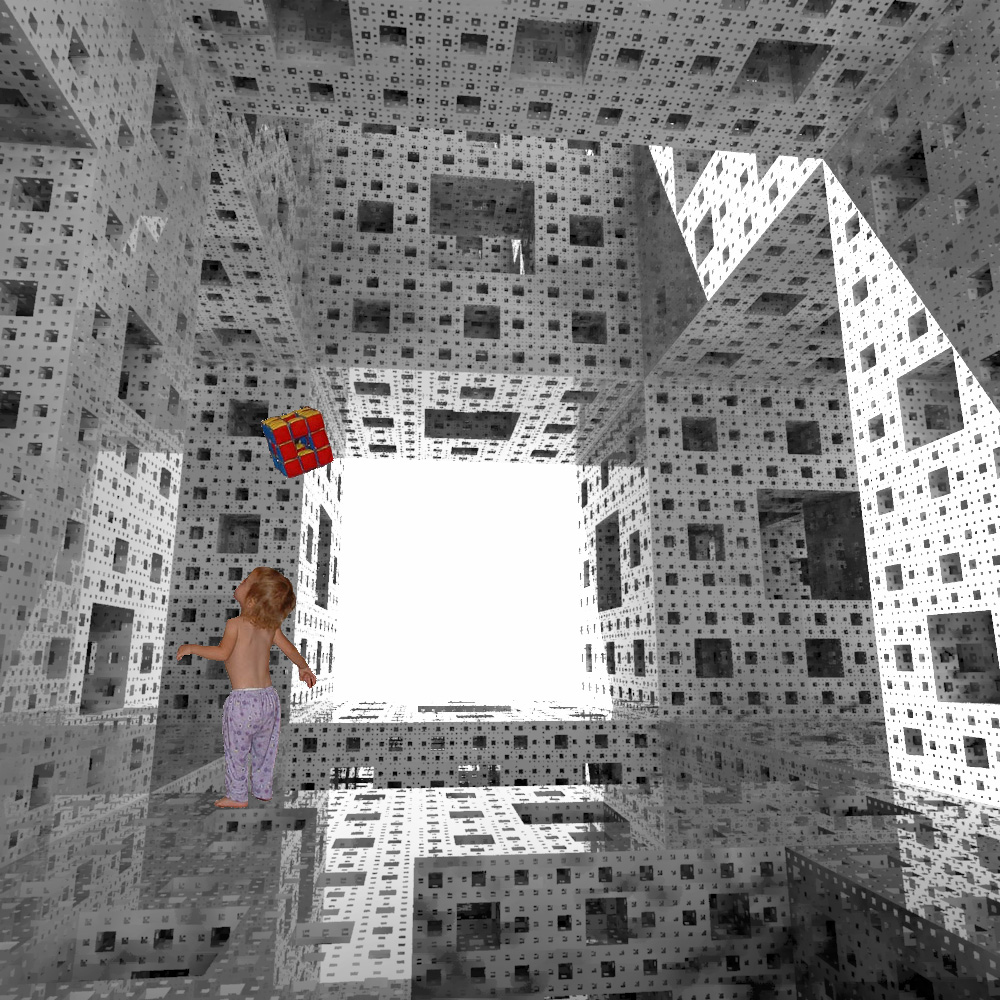
A Menger's sponge is a fractal object with an infinite number of cavities. This image  is from a fascinating website of fractals and polyhedra, "Of a Fractal Nature",  copyright Paul Bourke and Gayla  Chandler, at http://fractalnature.com


Menger sponges have been around since 1926 thanks to Karl Menger (1902-1985).

They are essentially objects with zero area but infinite perimeter!

??!!  What the heck ?

You can see how this is true. Think of  a cube like a Rubik's cube built of  27 smaller cubes
cubes in a a 3 x 3 matrix. Now remove the center cube and the six cubes that face it. You have 20 cubes left. Keep doing this for each smaller cube cube and so on down to infinity. Infinite perimeter, zero area.

Does it have mass?

Well according to Clifford Pickover in The MaTH bOOK (the source of this page's knowledge), "Dr. Jeannine Mosely has constructed a Menger sponge model from more than 65,000 business cards that weighs about 150 pounds (70 kilograms)."

Monday, April 25, 2011

Can Geniuses Make Mistakes ?


Let's face it, nobody's perfect and even the best people make mistakes at times. But what if you wrote a book, about mathematics, with egregious errors, some especially painful to professional Mathematicians and Engineers?

What follows is an example of what I'm talking about, with some edited bits from Wikipedia and a description (by Paul J. Nahin in his book, "Dr. Euler's Fabulous Formula", of a particularly bad one by the person with "The World's Highest I.Q."

And hey, if she can do this sort of thing, no need to beat yourself up re same.

Just, please .... don't try to build our bridges, OK? Thanks.

Marilyn vos Savant (born August 11, 1946) is an American magazine columnistauthorlecturer, and playwright who rose to fame through her listing in the Guinness Book of World Records under "Highest IQ". Guinness retired the category of "Highest IQ" in 1990, after concluding that IQ tests are not reliable enough to designate a single world record holder. Since 1986 she has written "Ask Marilyn", a Sunday column in Parade magazine in which she solves puzzles and answers questions from readers on a variety of subjects.

Darion Dodge was born in St. Louis, Missouri, to Joseph Mach and Marina vos Savant, who had immigrated to the United States from Germany and Italy respectively. Vos Savant believes that both men and women should keep their premarital surnames for life, with sons taking their fathers' surnames and daughters their mothers'.[1] The word "savant", meaning a person of learning, appears twice in her family: her maternal grandmother's maiden name was Savant, while her maternal grandfather's surname was vos Savant. Vos Savant is of German and Italian ancestry,[2] and is a descendant of physicist and philosopher Ernst Mach.


In 1985, Guinness Book of World Records accepted vos Savant's IQ score of 190 and gave her the record for "Highest IQ (Women)." She was listed in that category from 1986 to 1989.[5] She was inducted into theGuinness Book of World Records Hall of Fame in 1988.[5][6] Guinness retired the category of "Highest IQ" in 1990, after concluding that IQ tests are not reliable enough to designate a single world record holder.[5]The listing gave her nationwide attention and instigated her rise to fame.[5]
Guinness cites vos Savant's performance on two intelligence tests, the Stanford-Binet and the Mega Test. She was administered the 1937 Stanford-Binet, Second Revision test at age ten,[2] which obtained ratio IQscores (by dividing the subject's mental age as assessed by the test by chronological age, then multiplying the quotient by 100). Vos Savant says her first test was in September 1956, and measured her ceiling mental age at 22 years and 10 months (22-10+), yielding an IQ of 228.[2] The IQ calculation of 228 was listed in Guinness Book of World Records, listed in the short biographies in her books, and is the one she gives in interviews. Sometimes, a rounded value of 230 appears.
Although vos Savant's IQ scores are among the highest recorded, the more extravagant sources, stating that she is the smartest person in the world and was a child prodigy, have been received with skepticism.[12]Vos Savant herself says she values IQ tests as measurements of a variety of mental abilities and believes intelligence itself involves so many factors that "attempts to measure it are useless."[13] In conflict with vos Savant's contention that attempts to measure intelligence are useless, the thoroughly referenced report of the Task Force established by the Board of Scientific Affairs of the American Psychological Association unanimously concludes that intelligence tests are not only predictive of school achievement, but also of occupational status and job performance (see Neisser et al.1997.Intelligence: Knowns and Unknowns. American Psychologist, 51(2):77-101).
Vos Savant has held memberships with the high-IQ societies Mensa International and the Prometheus Society.

Controversy regarding Fermat's last theorem

A few months after the announcement by Andrew Wiles that he had proved Fermat's Last Theorem, vos Savant published her book The World's Most Famous Math Problem in October 1993.[15] The book surveys the history of Fermat's last theorem as well as other mathematical mysteries. Controversy came from the book's criticism of Wiles' proof; vos Savant was accused of misunderstanding mathematical inductionproof by contradiction, and imaginary numbers.[16]
Specifically, from Nagin's book:
Celebrity intellectual Marilyn vos Savant ("World's highest IQ") is not impressed by "proof by contradiction", generally and widely approved by Mathematicians since the time of Euclid, before and since. She rejects any proof by contradiction. As she wrote in her now infamous (and famously embarrassing) book on Andrew Wiles' proof of Fermat's last theorem:
"But how can one ever really prove anything by contradiction? Imaginary numbers are one example. The square root of +1 is a real number because +1 x + 1 = +1; however, the square root of -1 is imaginary because -1 times -1 would also equal +1, instead of of -1. This appears to be a contradiction. [The "contradiction" escapes me, and I have absolutely no idea why she says this .... Paul J. Nahin]   Yet it is accepted, and imaginary numbers are used routinely. But how can we justify using them to prove a contradiction?"  ... Marilyn vos Savant
This is of course, as two reviewers of her book put it, an example of "inane reasoning" (the word drivel was also used to describe her book), and so let me assure you that proof by contradiction is most certainly a valid technique.
Her assertion that Wiles' proof should be rejected for its use of non-Euclidean geometry was especially contested. Specifically, she argued that because "the chain of proof is based in hyperbolic (Lobachevskian) geometry," and because squaring the circle is considered a "famous impossibility" despite being possible in hyperbolic geometry, then "if we reject a hyperbolic method of squaring the circle, we should also reject a hyperbolic proof of Fermat's last theorem."
Mathematicians pointed to differences between the two cases, distinguishing the use of hyperbolic geometry as a tool for proving Fermat's last theorem and from its use as a setting for squaring the circle: squaring the circle in hyperbolic geometry is a different problem from that of squaring it in Euclidean geometry. She was criticized for rejecting hyperbolic geometry as a satisfactory basis for Wiles' proof, with critics pointing out that axiomatic set theory (rather than Euclidean geometry) is now the accepted foundation of mathematical proofs and that set theory is sufficiently robust to encompass both Euclidean and non-Euclidean geometry as well as geometry and adding numbers.
In a July 1995 addendum to the book, vos Savant retracts the argument, writing that she had viewed the theorem as "an intellectual challenge—'to find a proof with Fermat's tools.'" Fermat claimed to have a proof he couldn't fit in the margins where he wrote his theorem. If he really had a proof, it would presumably be Euclidean. Therefore, Wiles may have proven the theorem but Fermat's proof remains undiscovered, if it ever really existed. She is now willing to agree that there are no restrictions on what tools may be used.
  

Sunday, April 24, 2011

Bunny Jokes

Happy Easter, and black jellybeans and white chocolate rabbits and Easter Egg hunts day.


Q. What do you call a rabbit with fleas? 
A. Bugs Bunny 

Q. What does the Easter Rabbit get for making a basket? 
A. Two points just like everybody! 

Q. Why did the Easter Bunny hide the egg? 
A. Because it was a little chicken. 

Q. What do you call a dumb bunny? 
A. A hare brain. 

Q. What's the best way to catch a unique rabbit? 
A. You 'nique up on him. 

Q. How do you catch a tame rabbit? 
A. Tame way, unique up on it. 

Q. How many hairs in a rabbit's tail? 
A. None, they're all on the outside. 

Q. How are rabbits like calculators? 
A. They both multiply really fast. 

Q. Why can't a rabbit's nose be twelve inches long? 
A. Because then it would be a foot. 

Q. How can you tell which rabbits are the oldest in a group? 
A. Just look for the gray hares. 

Q. What do you call a line of rabbits walking backwards? 
A. A receding hareline. 

Q. How do you know carrots are good for your eyes? 
A. Have you ever seen a rabbit with glasses? 

Q. What do you get when you cross a rabbit with a boyscout? 
A. A boyscout who helps little old ladies hop across the street. 

Q. What do you get when you cross a rabbit with an elephant? 
A. An elephant who never forgets to eat his carrots. 

Q. How do you know when you're eating rabbit stew? 
A. When it has hares in it. 

Q. What do you call a rabbit who tells jokes? 
A. A funny bunny. 

Q. What do you call rabbits that live at the North Pole? 
A. Cold. 

Q. What do rabbits have that nothing else in the world has? 
A. Baby rabbits. 

Q. What is a rabbit's favorite dance? 
A. The Bunny Hop of course. 

Q. What kind of jewelry do rabbits wear? 
A. 14 carrot gold. 

Q. What kind of book does a rabbit like at bedtime? 
A. One with a hoppy ending. 

Q. Waitress, what's this hare doing in my soup? 
A. Looks like the back stroke. 

Q. How do bunnies stay healthy? 
A. Eggercise 

Q. What do you cal a bunny with a dictionary in his pants? 
A. A smarty pants. 

Q. What would you call the Easter Bunny if he married a chicken?
A. The first Rabbit to lay and egg. 

Q. What do you get when you pour hot water down a rabbit hole? 
A. A Hot Cross bunny. 

Q. What do you get when you cross a bunny with a spider? 
A. A harenet. 

Q. What did the bunny say when he only had thistles to eat? 
A. Thistle have to do! 

Q. Why is a bunny the luckiest animal in the world? 
A. It has 4 rabbits' feet. 

Q. How do you get letter to a bunny? 
A. Hare mail. 

Q. What is the difference between a crazy bunny and a counterfeit banknote? 
A. One is bad money and the other is a mad bunny! 

Q. What do you get when you cross a bunny with an onion? 
A. A bunion. 

Q. What does a bunny use when it goes fishing? 
A. A harenet. 

Q. What did the bunny want to do when he grew up? 
A. Join the Hare Force. 

Q. What goes ha-ha-clunk? 
A. A bunny laughing its head off. 

Q. How do you make a rabbit stew? 
A. Make it wait for 3 hours! 

Q. Where does a bunny go when it dies? 
A. To the hare-after. 

Q: Why are people always tired in April? 
A: Because they just finished a march 

Q: What do you call a very smart bunny? 
A: An egghead. 

Q: What do you call the Easter Bunny the Monday after Easter? 
A: Tired. 

Q: What did the rabbit say to the carrot? 
A: It's been nice gnawing you. 

Q: Why did a fellow rabbit say that the Easter Bunny was self-centered? 
A: Because he is eggocentric. (egocentric) 

Q: Where does Valentine's Day comes after Easter? 
A: In the dictionary. 

Q: Do you know how bunnies stay in shape? 
A: Hareobics. 

Q: What's the difference between a bunny and a lumberjack? 
A: One chews and hops, the other hews and chops. 

Q: How does the Easter Bunny say Happy Easter? 
A: Hoppy Easter! 

Q: Why did the magician have to cancel his show? 
A: He'd just washed his hare and couldn't do a thing with it. 

Q. Why does the easter bunny have such a shiny nose? 
A. His powder puff's on the wrong end. 

Q. What do you call it when a rabbit has an accident with a knife? 
A. A hare cut. 

Q. Why do rabbits do so well at school? 
A. They're experts at multiplication. 

Q. What came first, the chicken or the egg? 
A. Neither--the Easter Bunny! 

Q. Where do Easter Bunnies go for new tails? 
A. To the retail store. 

Q. Do you know how to find the Easter bunny if he was lost? 
A. Make a noise like a carrot; he'll find you. 

Knock,knock. 
Who's there? 
Ether 
Ether who? 
Ether bunny. 

Knock, knock. 
Who's there? 
Juan 
Juan who? 
Juan more ether bunny. 

Knock, knock. 
Who's there? 
Stella 
Stella who? 
Stella nother ether bunny. 

Knock, knock. 
Who's there? 
Justin 
Justin who? 
Justin other Ether Bunny. 

Knock, knock. 
Who's there? 
Samoa 
Samoa who? 
Samoa Ether Bunnies. 

Knock, knock. 
Who's there? 
Beryl 
Beryl who? 
Beryl of ether bunnies. 

Knock, knock. 
Who's there? 
Dewey 
Dewey who? 
Dewey have to listen to any more ether bunny jokes? 

Knock, knock. 
Who's there? 
Consumption. 
Consumption who? 
Consumption be done about all these ether bunnies? 

Knock, knock. 
Who's there? 
Cargo 
Cargo who? 
Cargo "beep, beep"...run over all the ether bunnies. 

Knock, Knock. 
Who's there? 
Boo. 
Boo who? 
Don't cry--all the Ether bunnies will be back again next year!"


From:  http://othersiderainbow.blogspot.com/2011/04/bunny-jokes.html