Danica McKellar, 35, and mathematically gifted, has added value to Humanity by writing a series of books on Mathematics for young girls. So much for the sexist "Girls aren't good at Math or Science" bullcrap.
She played "Winnie" on the popular American television series: Wonder Years. For a whole generation, she was pretty much every young guy's first girlfriend.
And now she's 35!
And a Mom!
Where oh where did the time fly?
Anyway, what follows is a nice piece on her joy of first-time parenthood as well:
It took Danica McKellar a day and a half of natural labor to deliver her sonDraco, but she barely recalls a moment of it.
“If I had known it was going to be 36 hours, I’m not sure I would’ve been able to do it,” says the former Wonder Years star, 35, who gave birth on Sept. 7 without an epidural.
“At the end I remember yelling, ‘Oh, come on!’ but besides that, I can’t remember what most of the labor was like!”
What she does remember clearly is meeting her son for the first time.
“There was so much joy in the room and so much relief!” she says. “It was instant love. It was an amazing, amazing evening.”
Since then, McKellar, her husband, composer Mike Verta, 38, and Draco have happily settled into their routine at home in Los Angeles. “Draco loves to listen to [his dad] play the piano,” she says. “I’m like, you don’t know that every daddy can’t do this!”
Her son’s name, which is the Latin word for dragon as well as a constellation, was her husband’s idea at first.
“He’d heard the name and loved it,” she explains. “He said, ‘Once we’re gone, the constellation will keep looking out for him.’ It makes me cry every time I hear it. So of course that made it a winner! I love it. It’s a cool, strong name.”
The author and actress has already lost 20 of the 40 lbs. she gained during pregnancy.
“I would crave whatever somebody was talking about!” McKellar laughingly recalls. “No matter what food it was. If somebody brought up lasagna, I would really want lasagna. Even liver and onions! It didn’t matter. All food sounded good. I was an omni-craver!”
As for her newborn son? “He’s really good-natured,” she says. “He likes getting his diaper changed. He seems to really appreciate that! And he has a ravenous appetite. He eats every three hours and I’m exclusively breastfeeding. He’s just really sweet.”
McKellar recently released her third math book, Hot X: Algebra Exposed, and is the voice of Miss Martian on Cartoon Network’s new animated teen superhero show, Young Justice.
Rene Descartes' famous "I think, therefore I am" has been re-examined and found to be untrue, according to the Department Head of the Rutgers University Philosophy Department.
"Indeed, quite the opposite is true. We have found that we do not in fact exist. In lieu of these findings, we have decided to take the moral high road and shut the Rutgers Department of Philosophy down for the time being, until such time as we can find the flaw in our reasoning, at which time, if and only if we come to said conclusion, we will ask Rutgers to be re-instated. In the meantime we will meet each morning over coffee at the local Panera's Bread restaurant to see if we can logically deduce how to re-instate our non-existent selves into our non-existent jobs."
Asked about this odd turn of events and how this came about, the Head continued.
"It began as a sort of a joke by one of our grad students, whenceforth most jokes spring. A few assistant professors took up her cause, and once a tenured professor took up the cause, well, you know where that leads.
"Briefly and without going into the details, you are aware of course of Rene Descartes famous 'I think, therefore I am', generally accepted by Science and Philosophy for hundreds of years. Our student questioned the assumption, which is of course what good philosophers do. She posited:
"'I think I think, therefore I think I am.'
"While seemingly an unnecessary extension into an Abstract Space of which Mathematicians are known/vilified for, this position led to some further developments, as so:
"'If I only think I am, this opens up the possibility that I am not, that I do not in fact exist, but rather am only given the illusion of my existence, however remote, and however small. Much like a creature in a video game such as Spore. This vexed us, because try as we might, we could not prove ourselves wrong.
"Since Philosophy is the source of most 'Interdisciplinary' studies, we decided to consult the experts in other fields.
"So we presented our case to a well-respected professor at Rutgers Physics, who reminded us of the phenomenon of Quantum Tunneling, that there was a small, but non-zero possibility, that we might be right. Well, we knew THAT! Why the hell did he think we were approaching him in the first place? However we were polite and nodded our heads in agreement and thanked him for his time, and quickly left lest he get it into his head we were crackpots, because the last thing we wanted was Rutgers Physics producing a professor who would think such of others.
"We then approached a professor at Rutgers Mechanical Engineering, and presented our case. His reply was 'If I understand you correctly, then for all practical purposes, given that the set of non-existent things is far larger that the set of existent things, and further given my knowledge of Thermodynamics that everything seeks equilibrium (which in your problem is non-existence), that nothing really exists. Heh, maybe that explains why I can't keep a positron trapped in my Quantum Computing experiments for more than a few weeks.'
"Astounded, we thanked him for his time, and asked if he'd ever considered a switch to Philosophy.
"'Thanks but no thanks,' he replied, 'But I prefer a job where things actually get done. Now if you'll excuse me, I have some non-existent tests to grade of some non-existent students and a short non-existent time in which to grade them before my next non-existent class.'
"'And so we retreated across the Raritan River from lovely Busch campus to our humble abodes on the College Avenue campus to ponder what we'd learned.
"After much discussion and to make a long story short, we concluded as follows:
"If there is even the smallest possibility of our non-existence, then in those such universes where non-existence is in fact the norm, those beings such as possibly ourselves in said non-existent universes would have no benchmark to prove, or disprove, their very existence, or not.
"Therefore, given the probability that non-existent things far outweigh the probability of existent things, it is most likely that we do not exist.
"Interestingly, as the last of our staff moved out of our offices, we noticed grad students from Physics and Mechanical Engineering had moved in, playing Spore."
Disclaimer: Everything on this post is fictitious. It is based on an article (which I lost!) of the Mugrat, being a parody of the Rutgers daily paper, The Daily Targum. The artwork of Descartes, which I very much like, came from searching Google Images and is by Jock Alexander of Sydney, Australia. http://jockalexander.blogspot.com/
"A poet once said 'The whole universe is in a glass of wine.'
We will probably never know in what sense he meant that, for poets do not write to be understood. But it is true that if we look at a glass closely enough we see the entire universe.
There are the things of physics: the twisting liquid which evaporates depending on the wind and weather, the reflections in the glass, and our imagination adds the atoms. The glass is a distillation of the earth's rocks, and in its composition we see the secret of the universe's age, and the evolution of the stars.
What strange array of chemicals are there in the wine? How did they come to be?
There are the ferments, the enzymes, the substrates, and the products.
There in wine is found the great generalization: all life is fermentation. Nobody can discover the chemistry of wine without discovering, as did Louis Pasteur, the cause of much disease.
How vivid is the claret, pressing its existence into the consciousness that watches it! If our small minds, for some convenience, divide this glass of wine, this universe, into parts - physics, biology, geology, astronomy, psychology, and so on - remember that Nature does not know it!
So let us put it all back together, not forgetting ultimately what it is for. Let it give us one more final pleasure: drink it and forget it all!"
... Richard Feynman
Feynman Flowchart (What Would Richard Feynman Do?) :
As you may have noticed, I have changed the name of my blog from the awkward and boring "Current Issues in Mathematical Physics" to "Multiplication by Infinity", a personally cheeky take on "division by zero," the dirty toilet in the Mathematical basement, not to be confused with Dave Richeson's wonderful weblog of the same name.
In Physics and Mathematics, we seek simplicity and bliss via symmetry and conservation laws, which offer many "dualities." But what of "trialities"? Garrett Lisi's continuing exploration into E8 Lie algebra is exploring just that. For this, mayhap, we shall consider Octonions.
What are Octonions, you may ask? Well first, that's an intelligent question. Beats me, I've just started studying them. Fortunately, John Baez wrote an awesome summary in 2001, the introduction of which, below, sums them up quite nicely, complete with Nineteenth Century Mathematical politics.
From Introduction, The Octonions by John Baez, 2001:
There are exactly four normed division algebras: the real numbers (), complex numbers (), quaternions (), and octonions (). The real numbers are the dependable breadwinner of the family, the complete ordered field we all rely on. The complex numbers are a slightly flashier but still respectable younger brother: not ordered, but algebraically complete. The quaternions, being noncommutative, are the eccentric cousin who is shunned at important family gatherings. But the octonions are the crazy old uncle nobody lets out of the attic: they are nonassociative.
Most mathematicians have heard the story of how Hamilton invented the quaternions. In 1835, at the age of 30, he had discovered how to treat complex numbers as pairs of real numbers. Fascinated by the relation between and 2-dimensional geometry, he tried for many years to invent a bigger algebra that would play a similar role in 3-dimensional geometry. In modern language, it seems he was looking for a 3-dimensional normed division algebra. His quest built to its climax in October 1843. He later wrote to his son, ``Every morning in the early part of the above-cited month, on my coming down to breakfast, your (then) little brother William Edwin, and yourself, used to ask me: `Well, Papa, can you multiply triplets?' Whereto I was always obliged to reply, with a sad shake of the head: `No, I can only add and subtract them'.''
The problem, of course, was that there exists no 3-dimensional normed division algebra. He really needed a 4-dimensional algebra.
Finally, on the 16th of October, 1843, while walking with his wife along the Royal Canal to a meeting of the Royal Irish Academy in Dublin, he made his momentous discovery. ``That is to say, I then and there felt the galvanic circuit of thought close; and the sparks which fell from it were the fundamental equations between ; exactly such as I have used them ever since.'' And in a famous act of mathematical vandalism, he carved these equations into the stone of the Brougham Bridge:
One reason this story is so well-known is that Hamilton spent the rest of his life obsessed with the quaternions and their applications to geometry [41,49]. And for a while, quaternions were fashionable. They were made a mandatory examination topic in Dublin, and in some American universities they were the only advanced mathematics taught. Much of what we now do with scalars and vectors in was then done using real and imaginary quaternions. A school of `quaternionists' developed, which was led after Hamilton's death by Peter Tait of Edinburgh and Benjamin Peirce of Harvard. Tait wrote 8 books on the quaternions, emphasizing their applications to physics. When Gibbs invented the modern notation for the dot product and cross product, Tait condemned it as a ``hermaphrodite monstrosity''. A war of polemics ensued, with luminaries such as Heaviside weighing in on the side of vectors.
Ultimately the quaternions lost, and acquired a slight taint of disgrace from which they have never fully recovered [24].
Less well-known is the discovery of the octonions by Hamilton's friend from college, John T. Graves. It was Graves' interest in algebra that got Hamilton thinking about complex numbers and triplets in the first place. The very day after his fateful walk, Hamilton sent an 8-page letter describing the quaternions to Graves. Graves replied on October 26th, complimenting Hamilton on the boldness of the idea, but adding ``There is still something in the system which gravels me. I have not yet any clear views as to the extent to which we are at liberty arbitrarily to create imaginaries, and to endow them with supernatural properties.'' And he asked: ``If with your alchemy you can make three pounds of gold, why should you stop there?''
Graves then set to work on some gold of his own! On December 26th, he wrote to Hamilton describing a new 8-dimensional algebra, which he called the `octaves'. He showed that they were a normed division algebra, and used this to express the product of two sums of eight perfect squares as another sum of eight perfect squares: the `eight squares theorem' [48].
In January 1844, Graves sent three letters to Hamilton expanding on his discovery. He considered the idea of a general theory of `-ions', and tried to construct a 16-dimensional normed division algebra, but he ``met with an unexpected hitch'' and came to doubt that this was possible. Hamilton offered to publicize Graves' discovery, but being busy with work on quaternions, he kept putting it off. In July he wrote to Graves pointing out that the octonions were nonassociative: `` , if be quaternions, but not so, generally, with your octaves.'' In fact, Hamilton first invented the term `associative' at about this time, so the octonions may have played a role in clarifying the importance of this concept.
Meanwhile the young Arthur Cayley, fresh out of Cambridge, had been thinking about the quaternions ever since Hamilton announced their existence. He seemed to be seeking relationships between the quaternions and hyperelliptic functions. In March of 1845, he published a paper in the Philosophical Magazine entitled `On Jacobi's Elliptic Functions, in Reply to the Rev. B. Bronwin; and on Quaternions' [15]. The bulk of this paper was an attempt to rebut an article pointing out mistakes in Cayley's work on elliptic functions. Apparently as an afterthought, he tacked on a brief description of the octonions. In fact, this paper was so full of errors that it was omitted from his collected works -- except for the part about octonions [16].
Upset at being beaten to publication, Graves attached a postscript to a paper of his own which was to appear in the following issue of the same journal, saying that he had known of the octonions ever since Christmas, 1843. On June 14th, 1847, Hamilton contributed a short note to the Transactions of the Royal Irish Academy, vouching for Graves' priority. But it was too late: the octonions became known as `Cayley numbers'. Still worse, Graves later found that his eight squares theorem had already been discovered by C. F. Degen in 1818 [25,27].
Why have the octonions languished in such obscurity compared to the quaternions? Besides their rather inglorious birth, one reason is that they lacked a tireless defender such as Hamilton. But surely the reason for this is that they lacked any clear application to geometry and physics. The unit quaternions form the group , which is the double cover of the rotation group . This makes them nicely suited to the study of rotations and angular momentum, particularly in the context of quantum mechanics. These days we regard this phenomenon as a special case of the theory of Clifford algebras. Most of us no longer attribute to the quaternions the cosmic significance that Hamilton claimed for them, but they fit nicely into our understanding of the scheme of things.
The octonions, on the other hand, do not. Their relevance to geometry was quite obscure until 1925, when Élie Cartan described `triality' -- the symmetry between vectors and spinors in 8-dimensional Euclidean space [14]. Their potential relevance to physics was noticed in a 1934 paper by Jordan, von Neumann and Wigner on the foundations of quantum mechanics [55]. However, attempts by Jordan and others to apply octonionic quantum mechanics to nuclear and particle physics met with little success. Work along these lines continued quite slowly until the 1980s, when it was realized that the octonions explain some curious features of string theory [60]. The Lagrangian for the classical superstring involves a relationship between vectors and spinors in Minkowski spacetime which holds only in 3, 4, 6, and 10 dimensions. Note that these numbers are 2 more than the dimensions of and . As we shall see, this is no coincidence: briefly, the isomorphisms
allow us to treat a spinor in one of these dimensions as a pair of elements of the corresponding division algebra. It is fascinating that of these superstring Lagrangians, it is the 10-dimensional octonionic one that gives the most promising candidate for a realistic theory of fundamental physics! However, there is still no proof that the octonions are useful for understanding the real world.
We can only hope that eventually this question will be settled one way or another. Besides their possible role in physics, the octonions are important because they tie together some algebraic structures that otherwise appear as isolated and inexplicable exceptions. As we shall explain, the concept of an octonionic projective space only makes sense for , due to the nonassociativity of . This means that various structures associated to real, complex and quaternionic projective spaces have octonionic analogues only for .
Simple Lie algebras are a nice example of this phenomenon. There are 3 infinite families of `classical' simple Lie algebras, which come from the isometry groups of the projective spaces , and . There are also 5 `exceptional' simple Lie algebras. These were discovered by Killing and Cartan in the late 1800s. At the time, the significance of these exceptions was shrouded in mystery: they did not arise as symmetry groups of known structures. Only later did their connection to the octonions become clear. It turns out that 4 of them come from the isometry groups of the projective planes over , , and . The remaining one is the automorphism group of the octonions!
Another good example is the classification of simple formally real Jordan algebras. Besides several infinite families of these, there is the `exceptional' Jordan algebra, which consists of hermitian octonionic matrices. Minimal projections in this Jordan algebra correspond to points of , and the automorphism group of this algebra is the same as the isometry group of .
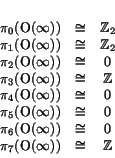
The octonions also have fascinating connections to topology. In 1957, Raoul Bott computed the homotopy groups of the topological group , which is the inductive limit of the orthogonal groups as . He proved that they repeat with period 8:
This is known as `Bott periodicity'. He also computed the first 8:
Note that the nonvanishing homotopy groups here occur in dimensions one less than the dimensions of , and . This is no coincidence! In a normed division algebra, left multiplication by an element of norm one defines an orthogonal transformation of the algebra, and thus an element of . This gives us maps from the spheres and to , and these maps generate the homotopy groups in those dimensions.
Given this, one might naturally guess that the period-8 repetition in the homotopy groups of is in some sense `caused' by the octonions. As we shall see, this is true. Conversely, Bott periodicity plays a crucial role in the proof that every division algebra over the reals must be of dimension 1, 2, 4, or 8.
[emphasis Steve's, which hopefully explains this post's title ... that's right, 16 won't work ... you have 4 choices those being 1, 2, 4 or 8]
In what follows we shall try to explain the octonions and their role in algebra, geometry, and topology.
In Section 2 we give four constructions of the octonions: first via their multiplication table, then using the Fano plane, then using the Cayley-Dickson construction and finally using Clifford algebras, spinors, and a generalized concept of `triality' advocated by Frank Adams [1]. Each approach has its own merits.
In Section 3 we discuss the projective lines and planes over the normed division algebras -- especially -- and describe their relation to Bott periodicity, the exceptional Jordan algebra, and the Lie algebra isomorphisms listed above.
Finally, in Section 4 we discuss octonionic constructions of the exceptional Lie groups, especially the `magic square'.
I got a very disturbing e-mail from "Anonymous" regarding Garrett Lisi's claim that he has had a paper published in a peer-reviewed Journal but that in fact no such paper has been published there.
I should very much like to have this resolved as I cannot locate the paper myself after half an hour of searching.
A link would be most appreciated, so that we can put this to rest and I can then delete this post. Here is the e-mail:
Fri, November 26, 2010 7:50:31 PM
[Multiplication by Infinity] New comment on Garrett Lisi in Real Time.
Peter Woit is deleting requests for Garrett Lisi to provide a full reference for the paper he claims he published in a peer-reviewed journal. I can find no such paper.
At Peter Woit's blog, Garret writes, "
No, but it’s wrong. The paper with Lee and Simone lays out 90% of the theory, and was published in J. Phys. A: Math. Theor. 43 (2010). Lee and I tend to just put papers on the arxiv, but Simone thought it would be good to put it in a journal. There was no problem getting it published."
But then we go to Garrett's wikipedia page which he is known to self-edit, and there is no mention of any such paper.
There is no mention of any paper with Simone, nor the J. Phys. A: Math. Theor. 43 (2010).
Why is there no mention of the supposed journal paper that was peer-reviewed which Lisi states he coauthored? Is Lisi lying about the existence of such a peer-reviewed paper?
In addition, there is no mention of Simone on the page.


 ), complex numbers (
 ), quaternions (
 ), and octonions (
 ). The real numbers are the dependable breadwinner of the family, the complete ordered field we all rely on. The complex numbers are a slightly flashier but still respectable younger brother: not ordered, but algebraically complete. The quaternions, being noncommutative, are the eccentric cousin who is shunned at important family gatherings. But the octonions are the crazy old uncle nobody lets out of the attic: they are nonassociative.
 ; exactly such as I have used them ever since.'' And in a famous act of mathematical vandalism, he carved these equations into the stone of the
 was then done using real and imaginary quaternions. A school of `quaternionists' developed, which was led after Hamilton's death by Peter Tait of Edinburgh and Benjamin Peirce of Harvard. Tait wrote 8 books on the quaternions, emphasizing their applications to physics. When Gibbs invented the modern notation for the dot product and cross product, Tait condemned it as a ``hermaphrodite monstrosity''. A war of polemics ensued, with luminaries such as Heaviside weighing in on the side of vectors.
 -ions', and tried to construct a 16-dimensional normed division algebra, but he ``met with an unexpected hitch'' and came to doubt that this was possible. Hamilton offered to publicize Graves' discovery, but being busy with work on quaternions, he kept putting it off. In July he wrote to Graves pointing out that the octonions were nonassociative: ``
  , if
, if  be quaternions, but not so, generally, with your octaves.'' In fact, Hamilton first invented the term `associative' at about this time, so the octonions may have played a role in clarifying the importance of this concept.
 , which is the double cover of the rotation group
  . This makes them nicely suited to the study of rotations and angular momentum, particularly in the context of quantum mechanics. These days we regard this phenomenon as a special case of the theory of Clifford algebras. Most of us no longer attribute to the quaternions the cosmic significance that Hamilton claimed for them, but they fit nicely into our understanding of the scheme of things.
 and
and 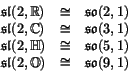
 only makes sense for
  , due to the nonassociativity of
  ,
,  and
and  . There are also 5 `exceptional' simple Lie algebras. These were discovered by Killing and Cartan in the late 1800s. At the time, the significance of these exceptions was shrouded in mystery: they did not arise as symmetry groups of known structures. Only later did their connection to the octonions become clear. It turns out that 4 of them come from the isometry groups of the projective planes over
  ,
,  and
and  . The remaining one is the automorphism group of the octonions!
 hermitian octonionic matrices. Minimal projections in this Jordan algebra correspond to points of
  , and the automorphism group of this algebra is the same as the isometry group of
  , which is the inductive limit of the orthogonal groups
  as
as  . He proved that they repeat with period 8:
 and
and  to
to 